Showing posts with label guided reading. Show all posts

Wednesday, July 8, 2015

The Crossover


Let's all just pretend that I've been updating my blog regularly and it hasn't been sitting, getting dusty in some corner of the Internet, okay? :-)

An apology: new evaluation system in NYC nonsense/first grader involved in too many activities/dissertation length lesson plans/marathon training/death of my doggie/adoption of a puppy/maintaining a marriage = something had to give.  And now that it's summer I hope I'll be able to blog more regularly (although my soon-to-be second grader is still involved in too many activities!).
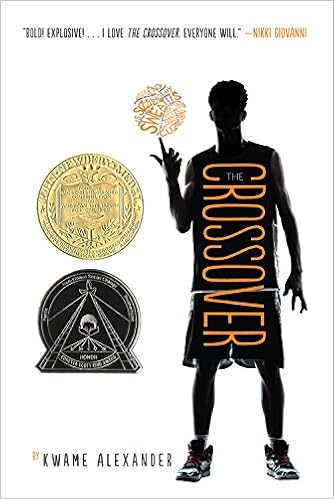

I did, however, have time to read the best book I've read in years.  The Crossover by Kwame Alexander won the Newbery Award this year and it is fabulous.  The book is written in free verse and in the vernacular of today's kids.  When I read the book aloud to my class at the end of the year, one of my students kept remarking that she could tell the book was "modern" because of the way it was written (love that!).

The story is narrated by Josh, aka Filthy McNasty, an African American boy who loves LOVES basketball and is great at it.  He is the only seventh grader on his team who can dunk.  His father played professional ball for a European team and won a championship ring before he was sidelined by an injury.  Josh is also a twin.  His twin brother Jordan, or JB, also plays basketball, but develops a new interest in girls, leaving Josh feeling alone.  The text brings you through the changes that Josh unwillingly experiences because of the choices of people around him.

My students loved this book.  I had so much fun reading it aloud to them.  It's filled with basketball trash talk and rhymes (See, when I play ball,/ I'm on fire./When I shoot,/I inspire./The hoop's for sale,/and I'm the buyer.)

Entwined into the story, the author wove several vocabulary words that have their own chapters and Basketball Rules, which are really rules for life.  My favorite rule is #3: "Never let anyone lower your goals.  Others' expectations of you are determined by their limitations of life.  The sky is your limit, sons.  Always shoot for the sun and you will shine."

While this is a text that refers to basketball (A LOT) I don't think it just appeals to kids who are interested in sports stories.  This is a highly engaging text that will appeal to many readers in your classrooms.  I especially think that this is a book for your most reluctant readers.  Kids who are entering their tween and teen years will relate to the drama of young love and the chapters are short and easy to digest.  Pertinent vocabulary is explicitly defined within the text as well.

I'm currently planning a novel study for my fifth graders next year using this text.  I've posted a comprehension booklet on TpT:


 This packet includes 22 pages of higher order thinking questions, a project choice board and a full answer key with teaching ideas for the teacher! I've also included a CCSS anchor standard alignment, which you can see in the preview.  As always, this resource is posted at a discount from today until 7/10 around 9pm.

I also wanted to share a free resource: a vocabulary trifold for The Crossover.  You can use this download to help students define the vocabulary from the text or to write sentences using the words they've acquired.  Click on either image to download from Google Drive:


Tell Me: Has anyone else read The Crossover? The next book on my list is Brown Girl Dreaming by Jaqueline Woodson.  I have quite a few books for older readers, but I need more current books for third and fourth graders.  Any suggestions?

Wednesday, May 1, 2013

Workshop Wednesday: Favorite Reading Group Book

I'm linking up with Ideas by Jivey for Workshop Wednesday!  This week's topic: favorite reading group book.

My favorite reading group book is Tuck Everlasting, by Natalie Babbitt.  If you've never read it, it's the story of a girl named Winnie who stumbles upon a boy and a spring in her woods.  She is kidnapped by the boy, his brother and their mother who try to convince Winnie that the spring has the power to stop time for who ever drinks it.  The family tells her that they stopped aging eighty years ago when they drank the water and they need her to help them keep their secret.


I read this book for the first time when I was in sixth grade.  I remember loving the scene with Winnie sitting in the row boat with Angus Tuck as he tried to explain to her why he wishes he could get back on the wheel of life, even if it means his eventual death.
Everything's a wheel, turning and turning, never stopping. The frogs is part of it, and the bugs, and the fish, and the wood thush, too. And people. But never the same ones. Always coming in new, always growing and changing, and always moving on. That's the way it's suppose to be. That's the way it is. If we didn't move it out ourself, it would stay here forever, trying to get loose, but stuck. That's what us Tucks are, Winnie.
I've shared this book with classes as a read aloud for many years, but this was the first year I decided to read it with a reading group.  For read aloud, it prompted great discussion and debate amongst the class about immortality and what we wanted Winnie to do.  I think I really preferred this book as a reading group book because I got to see how my students changed their opinions over time as they read.  When you hear 20 something opinions, it's very hard to keep individual opinions straight, but when you are reading with just 5 students, it's much easier to remember how each student feels and how their opinions change.
 Prereading homework
As a reading group book, it also gives students the space to mull over Winnie's feelings for Jesse.  For many of my students, especially those that read far below their grade level, it's the first time they've encountered a hint of romance in their books!

The book is so rich and so beautifully written that the movie version is just such a disappointment. I let my students watch it, although there is a little bit of kissing in it, but it's just not good movie!  It doesn't do the story justice and there are extra parts added in for no good reason.

Glencoe offers a great (and FREE!) study guide for the book.  Click here for the pdf.

What is your favorite reading group book? Be sure to link up with Ideas by Jivey to share!

Wednesday, April 10, 2013

Workshop Wednesday: Reading Groups Organization

I'm linking up with Ideas by Jivey for Workshop Wednesday! This week's topic: reading groups organization.  Here's a little peak into my guided reading organization!

Ugh!  Glare!

I keep everything for guided reading in my guided reading binder: class lists, groupings, lesson plans and conference notes.
 
The first page in my binder is a flexible grouping sheet that my school provides.  We use this sheet to note the groups of students and their instructional focus.

I use a few gradebook pages from BusyTeachersCafe to keep track of the center rotations for the week.  I list the centers along the top to keep track of which student has been to which center during the week.  It's a little sloppy by the end of the month, but it gets the job done!
  You may notice that there are some students who do not go to centers.  This is because we have AIS and ESL during reading workshop, so those students are pulled out.

I use the same gradebook page to keep track of my reading conferences.  This page is from the first marking period, so it's a bit sparse.  I just note the date of the conference on the gradebook page. 
The rest of my binder is organized by guided reading group.  I keep my lesson plans and observation sheets in those sections.  
My school has one uniform conference/observation sheet that we all use:
This stays in the binder as well until it is completely filled in and then I move it to my data binder.

For lesson plans, I keep most of my questions in stickies in my books, but I like to jot down a few ideas before I start the lesson.  I made this little sheet to write my plans for two days of guided reading.  
I like having two days side-by-side.  It helps me remember what we've discussed and where we are headed. 

If you want to grab any of these forms, you can download this freebie from my TpT store!
Be sure to link up with Jivey to show how you organize your reading groups!


Thursday, April 4, 2013

Teaching Students to Question

Last week, I blogged about starting The One and Only Ivan by Katherine Applegate with my reading group.  Well, yesterday was the big day!  My kids were really impressed by the size of the book and the fact that it has a hard cover (LOL!).

After introducing the book, I briefly revisited "thick" and "thin" questions.  We've written "thick" and "thin" questions together as part of our read alouds, but this was the first time I was working with this group of readers on questioning.  Click HERE to download posters!


I told the group that they would be responsible for writing the questions we would discuss after reading.  I assigned the chapters "hello" though "the littlest big top on earth," which is about ten pages but with a lot of white space and some images.  As they read, I kept the "thick" question starters up on the SMARTboard to help them out.  They had the option of recording their questions on a sheet I made, or on their stickies.

Sounds good, right? 

It was disaster.

Not a complete disaster though.  One of my students, C, did a FANTASTIC job writing thought provoking questions to ask the group.  He was awesome.

Why does he compare himself to humans?
What does he tell us about himself and how he feels?
Where does he live?
Why does he live there?
Who are Stella and Bob?
 The other three students really struggled.  It was painful.  Even with the question starters, they weren't able to piece together questions that even made sense.  I started conferencing with one of my students and I could see that the mini lesson just wasn't enough, but I was kind of baffled as to why???

During my crazy long commute home, I kept thinking about how this group could not put a question together.  I kept coming back to two things:  first, culturally, many of my students are told to come to school, be quiet and listen to the teacher.  Therefore, they are not used to being the questioner.  Second, the task was just too broad.  Even though the text was short, it would require my readers to take a huge risk to write a question worthy of good conversation.  Since there isn't too much I could do about the first thing, I did think I could do a better job with the task, so I scrapped my plans and decided to meet with this group again this morning.

This time, I gave C a writing response while I worked with the other students on QAR.

Right There - Who is Stella? 
Think and Search - What is on the domain walls?
In My Head - Why is Ivan never angry?  Who is the elephant on the cover?


I selected just one page to text to read with them.  As we read, I modeled writing Right There Questions for a few sentences.   
"My domain is at the end of one ring."  Where is Ivan's domain? 
"Stella is an elephant."  Who is Stella? 

Quickly, I saw my readers more willing to ask questions, even if they were the "thin" questions.  We moved on to writing Think And Search Questions, first together, then independently.  Finally, we tried writing thicker, In My Head questions.  My readers still needed assistance, but were more willing to try.  Rome wasn't built in a day, right?

Coincidentally, one of the questions my readers posed was the same question I asked C to write about!  
A silver back uses anger to maintain order and warn his troop of danger. Anger is for protection.  But Ivan don't go no one to protect.

Update: I just created a reading response booklet to use with The One and Only Ivan.  It contains questions for most chapters of the book.  Check it out on TpT:


Tell me, how do you teach questioning?

Tuesday, February 19, 2013

Book Share: Sounder


I'm linking up with Sunny Days in Second Grade to share one of my FAVORITE books, Sounder by William H. Armstrong. 

 Sounder


If you've never read it, its the story of a young African American boy and his family living in a post slavery South.  The family, a mother, father, older boy, younger children and a dog named Sounder, is very poor and has difficulty making ends meet.  During the winter, the father takes Sounder out for hunting.  The author pours love into his description of the dog's voice and ability to hunt.  One evening, while the dog is in the hills hunting, the police come to the cabin to arrest the father.  The father is accused of stealing food and is arrested in a brutal, difficult to read scene.  While being taken away, one of the sheriff's men shoots Sounder, who has returned and is attempting to protect his master.  The mother ushers her oldest son back into the house even though he is desperate to tend to his wounded dog.  The reader is left to worry about Sounder and the father for many chapters.  The remainder of the story follows the older boy's life as he must grow up rather quickly.

I have a love/sorrow relationship with Sounder.  One the one hand, it's exquisitely crafted.; a perfect piece of literature to use for author's craft. The story is developed through rich description, has a great deal of foreshadowing and contains many biblical allegories.  On the other hand, the scene in which Sounder is shot and the subsequent description of his wounds just hurts my heart.  I always warn my students about the contents of the book before we begin our guided reading.

Another word of warning, while the sheriff and his men are arresting the father, they call him the most deplorable, degrading word possible.  Before we read, I tell the students they are going to read a word that is very unusual in books for young people and that they will know the word when they find it.  I ask the students to pause and write their response to the scene and the man who used the word on a sticky note.  We've had excellent discussions about this portion of the book.  Anticipating a long conversation about the father's arrest, I always plan for a very short reading time and and a very LOOOOOONG discussion.

If I had one difficulty with teaching this book, it's that the chapters are quite long and there are few clean breaks, especially when the students are only reading 10-15 minutes of text at a time.  The minimal dialogue makes the reader really have to work to build the story.  Although Fountas and Pinell call this book a level T, I've had more success and better conversation reading this book with higher level readers.

If you enjoy this book, you might want to check out this very thorough {and FREE} literature guide published by McGraw Hill: Sounder Literature Guide

Have you taught this book?  What is your favorite book to teach?