Friday, March 8, 2013

Showing Your Work

I may have had a breakthrough with my class.  After months of repeating "show your work" and "show me all of your thinking," I had a FULL CLASS put their thinking on paper today! Hooray!

On Fridays, we add test prep to our math block.  We reviewed how to find equivalent fractions and I modeled how I eliminated wrong answer choices by showing the math next to each choice.  When I released the kiddos to their independent work, this was what I saw:

Um, what?!  I'm smiling RIGHT NOW looking at this paper again!

And perhaps whipping my phone out to grab a picture of her work convinced her classmates that justifying our answers is awesome, because I found a lot of kids with math all over their papers.

Boom.  Justifying.  LOVE IT!

One more, just for good measure.


Literally (and I'm a teacher, so you know I take that word seriously) every student was showing their thinking like this today.

Now aside from it being awesome that they did what I asked them to, there is a ton of value in their ideas being scrawled across the page.  Here are a few reasons why I love showing some work or thinking for each of the answer choices:

1.)  It makes multiple choice practice a bit more rigorous.  By justifying why choices are wrong, they have to think critically.  It helps them develop their reasoning skills when they can give reasons why an answer is incorrect.

2.)  It makes them savvier test takers.  This may not be the ultimate goal, but I think students should know as much as is developmentally appropriate about testing and test creation. They should know how to use process of elimination and they should understand that there are "distractors" for all test items.

3.)  It immediately identifies students who are on the wrong track.
While this student was able to do some justifying for the first item, he ran into a road block for the second item.  You can see that he doesn't really understand what the question is asking him, so he tries out some reasoning, but his strategies do not result in an answer.

4.)  It slows them down. Throughout the years, I've found the vast majority of students will race through a math test, even THE test and complete it with plenty of time to spare.  And while some may flip through the booklet when they are done, they aren't really checking their work.  They may end up taking longer to complete the test, but they weren't using all of those extra minutes at the end anyway!

My kids are taking a diagnostic test on Monday, so I'm definitely going to talk to them about showing their thinking and paying attention to the amount of time they have left!


Tell me, how much work do you ask your students to show? 
 

Tuesday, March 5, 2013

Using Data to Drive Choices in Math Workshop

As teachers, we used data all of the time.  We use data to plan our lessons, to form our groups and to evaluate our students.  This is the first year, I've given my students the responsibility of making choices in our math workshop based on their data.  I found this picture on Pinterest and decided to do the same thing.


{Taking a very deep breath.}

Here is our data from after the first benchmark math test, given some time in December.

No judging.  The chart isn't about judging.  The chart is about staying focused on our goals and working together to achieve them.

I'm sure some of you have immediate reactions to this information being so SO public.  I was a bit worried about that also.  I was worried that some of my students would feel horrible seeing their names under "I need help do to this."  But that wasn't the case.  When I showed them the chart, (whose name is stolen from The Book Whisperer), I explained what each part meant and how they should use it.  Instead of being depressed or paralyzed, I found the students to be VERY motivated to more out of the "help" category and toward the "expert" category.


Looking back at My Teacher Friend's post, I am using the same percentages as she is, but rather than writing 0-59% I wrote "I need help to do this."  For 60-84%, the students are under "I can do this most of the time."  And for 85% and above, the students are "experts."  Along the left side, I used I can statements written from the Common Core Standards.  For this benchmark, the students were expected to add and subtract decimals to the hundredths, multiply whole numbers using the traditional algorithm and divide whole numbers using the traditional algorithm.

One quick glance at this chart can tell you exactly what I wanted to review first.  And the students were able to use this data also when I made these:

I love binders for center activities.

In our school, we use the EnVisions Math Program.  I decided to abandon their games and instead have the kids chose their own task cards based on their data.  They can also use the task cards in our small group tutoring program or if they finish work early.

Each one of the "I Can" statements has a set of task cards for the kids.  The sets are fairly small, just 6 cards with the answer cards in the baggie, so the students can self check their work.  They look at the data chart, find their name in one of the categories and they self select the task cards.  They can also use the chart during our workshop to locate an expert to help them if I'm busy with a small group.  Once they finish the task cards (for one standard) and check their work, they can request an assessment.

Oh yes.  They REQUEST assessments.

I bought Miss Nannini's Standards Based Common Core Assessments for Fifth Grade to use after the students complete their task cards.  They complete the assessments and I mark them right away.  If they score into the next level on the chart, they get to move their sticky notes.  They love it.

Here you can see how many sticky notes have moved from the "I need help" category to the "I can do this" and even all the way to expert!  I have several students who have really put a tremendous effort into moving all of their sticky notes into "expert."  Those little pink stickies really stand out when they make it to expert!

THIS is what the data chart is about.  It's about celebrating student achievement, no matter where our students begin.

I don't want to pretend I have this all figured out, because I don't.  I've found one way to help my kids focus their efforts in math workshop.  One in which we ALL share the data and the responsibility.


Tell me, is your data public?


Sunday, March 3, 2013

Prepositions Mini Unit and a Sunday Sale!

I finished teaching and editing my Prepositions Mini Unit for Fifth Grade this week!  Hooray!  I was really happy the level of engagement on a grammar topic.  I also felt like it really benefited my ELL students to get more experience using words like "with" and "for."  Even some of my advanced ELL students learned something new during this unit. 


I only have about 15 minutes a day to address grammar, so this unit took me 8 days to complete. I outlined the first few days of instruction in this post.


After we sorted sentences, I sent students home with a 1/4 sheet of paper to write their own sentences that used a preposition that told when or where.  The next morning, we sat in a circle and passed our sentences around and wrote the sentences on this chart.

I asked the kids to circle the preposition, as many of the sentences told when and where.  I collected their papers to check up on their progress and was very happy that even if the sentence had two prepositions, they were able to circle the one that matched the way they place it on the chart. They did a great job!


Next up: prepositional phrases.  Since they were already comfortable with prepositions, this mini lesson was a breeze!


Oh, sorry for the glare!  We  were circling prepositions, underlining the phrases and writing if the sentence told us when or where.  I had the students complete their sheets first and then come to the SMARTboard to review.

On our last day of instruction, I introduced prepositions that show relationships.  This is the area of need for my class going forward.  We looked at sentences with prepositions such as "of" and "from."  Then the students completed a worksheet and then we discussed all of the possible answers that made sense in the sentence.

In this package, I've also included an assessment and all of the answer keys to the sheets.  I opted not to give the assessment just because we've been doing a ton of mid year assessments and I really feel bad for my kids :-(


To say thank you for following me, I'm posting this mini unit and my Common Core and Commas mini unit (also aligned for Fifth Grade) for 25% off from now until Tuesday night, around 9pm.   If you do decide to pick it up, I'd love it if you left me some feedback!

Have a great Sunday!

Friday, March 1, 2013

Literature Circles

I'm pretty sure that literature circles are my favorite part of my classroom right now!  This is my first year having literature circles, well circle,  as a part of my balanced literacy program.  My group formed in January and they are on their third book right now. 

Here is a quick glimpse into literature circles in my room:

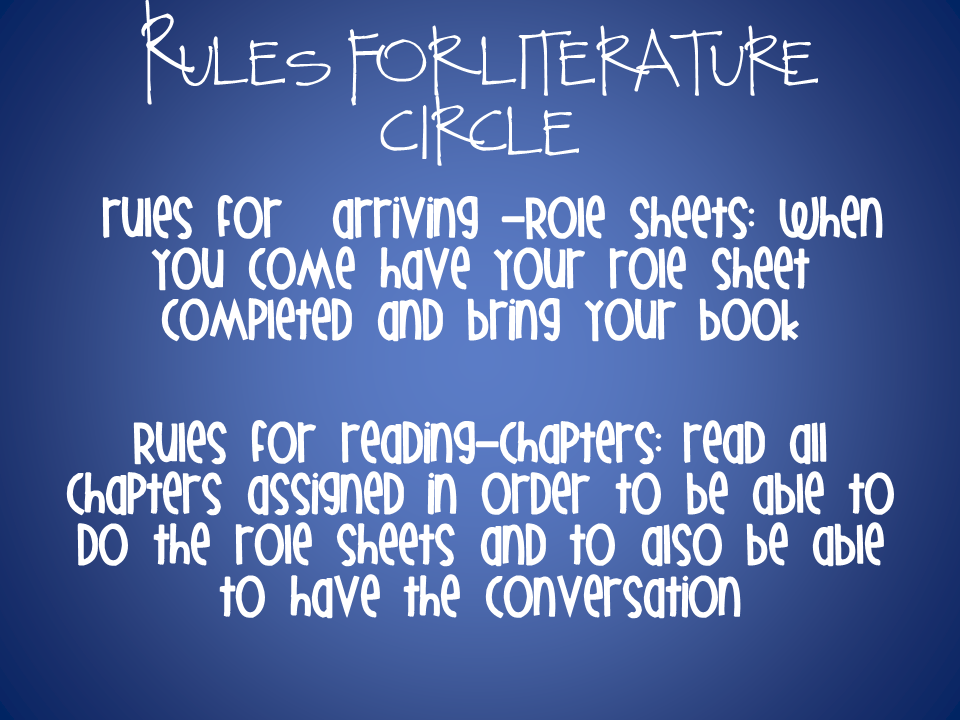
The literature circle group keeps their folder amongst my mess.  They have one folder with a sign in sheet, a list of expectations and a calendar.  Here is a look at the list of expectations that they created:


 I've actually just taken away their role sheets.  Now they get a few stickies and I expect all of the students to come to literature circles prepared with questions, connections and quotes to discuss.


The group uses the calendar to set their homework and decide when to meet next.  I generally have a bit of input about when they should meet.  Lately, we've been favoring Mondays and Thursdays.

Every once in  awhile, I pop into their meetings to listen to their conversations.  When I do, I usually scribble take notes as a transcript.

After they are done, I talk to them about what I noticed about their conversations and usually do a mini lesson about social skills.

At other times, I do a bit of assessing by asking the students to reflect on their experience in literature circles on that day.  When I notice their conversations are beginning to slow down, I'll drop off a sheet for them to complete before they adjourn for the day.

This response asked the students to select the most important question asked during their circle.  All students responded with a very similar idea and elaborated on why the question was so important.  A quick and easy way to make sure the students are on task and on target in their reading and in their conversations!

So tell me, do you do literature circles in your classroom?


Tuesday, February 26, 2013

The Lorax and Analyzing Images

We are taking a pause in our study of Lewis and Clark to get ready for Read Across America Day!  In the upper grades, we celebrate by sending our students to read to the littler kids.  They will practice all week to read the books they've chosen fluently.  It's so cute!


We started sharing The Lorax by Dr.Seuss today.  We actually only read a very small part of the text this morning because we focused on analyzing imagesI made this chart for recording their observations about what they saw on the cover and what they saw on the Street of the Lifted Lorax.  Those weird things around "The Lorax" are supposed to be truffula trees.  LOL!  I tried!


This was a great opportunity to get the students to think from the perspective of the author and illustrator and really dig deep into how images impact a text (Hello, Common Core!).  And may I confess that while prepping for this lesson, it was the first time I really REALLY spent time looking at the pictures. For instance, I never really noticed the connection between the cover and the second page "if you look deep enough you can still see, today, where the Lorax once stood just as long as it could." 

Some key questions:
* What feeling do you get by looking at the cover?
* How does the Street of the Lifted Lorax compare to the cover image?
* What do you think the author wants you to look at on this page?
* How does the image relate to the words on the page? {This was a differentiated question to allow my newest English speakers the chance to participate.}
* Who is telling this story so far? How can you tell?  {The narration is in third person until the Once-Ler begins telling his tale.}

We only read the first few pages! I don't usually stop so frequently for questioning, but I thought it was important to discuss each new image.
This is our chart from the end of our (mini) read aloud.  I'm really happy with the beginning of our analysis!  I was able to introduce my kids to the words dreary and desolate and the kids wrote some great responses about the mood along the Street of the Lifted Lorax.  By the end of the week, we will add onto our chart by analyzing images of the Once-Ler's arrival and images of the Once-Ler's factory.

Of course, I don't think you can read this book without discussing the impact of the Once-Ler's actions on the environment and questioning whether he has a right to "biggering and biggering" his company, so we will do a bit of on demand writing to tackle these topics.  These conversations will lead us to understanding Dr.Seuss's point of view, something my kids are still struggling to identify.

I'm also planning to work with a small group to complete a cause and effect organizer that I made....click below to grab your own copy :-)


So tell me: what do you have planned for Read Across America Week? 

Sunday, February 24, 2013

Teaching and Tapas Giveaway!

I've linked up with Teaching and Tapas' amazing giveaway!  She's giving away 100 products and there are lots of ways to enter :-)


I'm giving away my Common Core and Commas.  I had really great success teaching my students how to use commas with this product!  The students learned to use commas and semi-colons to separate items in a list, to offset yes or no, direct addresses, introductory phrases and tag questions.


Be sure to head over to Teaching and Tapas to enter! You have until March 3rd to enter!


Saturday, February 23, 2013

The Purpose of Prepositions {FREEBIE}

We spent a lot of time this week working on prepositions.  This is an area of difficulty for many English Language Learners.  I often have students who misuse the words "for" and "so."  And it's difficult teaching the purpose of so many "little" words.  But this week, I tried to break it down by sorting prepositions into two groups: when and where.

I started by briefly defining the role of  a preposition and then having the students identify the prepositions they were using in their sentences to describe the what they saw in this picture:


 They said that the net was ABOVE the girl, the ball bounced ON the floor, she will shoot the ball THROUGH the air, etc. Verbally, they did a great job!  So we moved onto a very quick worksheet I made.  The students used the words in the word bank to complete the sentences with prepositions that show where.  Here we ran into a little trouble.

A few of my students had difficulty with sentences such as "The barbeque was ___ my uncle's house."  I read more than a few "on my uncle's house." We talked about what that would look like {although, in this city, it's not necessarily impossible for a barbeque to be ON someone's home!}.

On the bottom of the sheet, the students wrote a sentence using a preposition to show where.

The next day, we talked about prepositions that tell when.  This one seemed much easier for the students to understand, although we did talk a lot about the word "by."


They worked on another set of sentences and then wrote their own sentences to tell when.  From this student, I can see that she is able to complete the sentences, but she is still showing some confusion about using the word "in" to show when.  {She wrote "the book City of Ember is in my desk."}

On the third day of working with prepositions, I had my students sort sentences with prepositions that show when and where.  Each student received a sentence and collaborated with a partner to find the preposition and then tape it to the correct poster.


This was another great opportunity for a quick assessment.  By glancing at the posters, I was able to identify two partnerships that had difficulty with  either identifying the preposition or determining how it functions in the sentence.

For homework, I gave the students a blank card and asked them to write a sentence with a preposition that shows when or where, their choice.  On Monday, I'll tape the words around the room and they will walk around the room and write the sentences on a T-Chart!  I also plan to extend their learning to prepositional phrases and prepositions that show a relationship.

While I'm not done with the entire package, I'd like to offer the sentences to sort as a freebie.  Click HERE to download the sentence headers and 12 sentences to sort from my TpT store!
 

Enjoy!